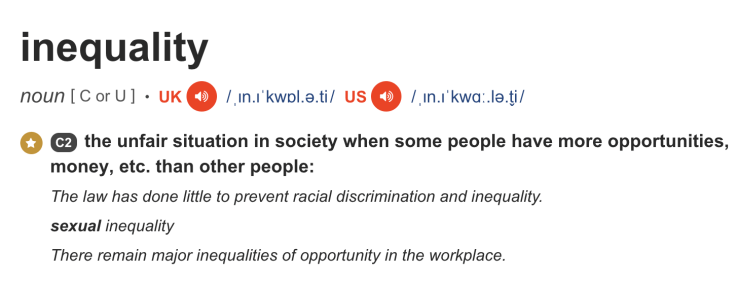
What is inequality exactly ?
Inequality is essentially the state of not being equal, especially in status, rights and and opportunity. This can involve a great deal of things with issues that are small scale all the way to world affairs such as Environmental inequality which can affect the whole planet.
What causes inequality ?
1. Starting points – The situation that each of us are born into. If you’re born into a family with wealth and assets, you get a head start. That’s particularly important for Britain, as long held land ownership inequalities and networks of inherited wealth form a base of initial conditions that perpetuate inequality. A recent report showed that it also helps to be male and white. Women earn 21% less than men, and men of Bangladeshi or Black African descent earn 13-21% less on average than their white counterparts.
2. Early life opportunities – Your childhood can amplify initial inequalities that you were born into. Families with wealth are able to pay for better education for their children, opening doors to all kinds of opportunities. Britain has very poor social mobility, which means that those born into disadvantaged households are likely to remain disadvantaged themselves.
3. Global influences – Globalisation is a phenomenon that has brought lots of advantages yet it seems to be a double edged sword as it also drives a great deal of inequality. The collapse of the Soviet Union and the rise of China brought over a billion new workers into the global economy. One of the many effects of this has been to lower the value of unskilled labour, right around the world, pushing wages for skilled workers and unskilled workers in different directions.
4. Taxation – The tax regime of any country can be progressive or regressive, redistributing wealth around the economy. Taxation is one of the first things we think of when talking about sharing the wealth, but it’s much better to prevent inequality from developing in the first place than to redistribute it afterwards. However, a progressive tax system can move society in the right direction and help prevent inequality passing from one generation to the next.
5. National economy – The wealth gap that exists within a nation. In a variety of countries the wealth gap has been growing between everyone and the top 10%. Countries such as America and the UK have seen a great wealth divide which has been the result of those in the top 10% reaping the greatest benefits instead of the working classes.
Inequality – A real world problem
Inequality is increasing each and every year. It is a growing concern and one that has been growing since 1980, reports show that there has been rising inequality occurring at different speeds in most parts of the world. Even in Europe where it is less pronounced, ethical concerns have been raised. In Western Europe, many do not receive a real living wage, despite working hard, often in full-time employment. Plus, data shows that the top 10% of earners in Europe as a whole still hold 37% of the total national income in 2016.
Income inequality should be focal to public debate due to it also being a factor that motivates human behaviour. It affects how we consume, save and invest. For many it determines whether their children will go to school and wether or not they will get good quality education. This, in turn, may affect economic growth, raising the question of whether it is economically efficient to have unequal societies.
 Emerging Technologies in Graphic Design